Business Continuity & Operational Resilience
A plan you've never tested isn't continuity
DORA, NIS2 and ISO 22301 don't ask whether you have a document; they ask you to prove you can recover. ResiliencePilot takes you from “what's critical?” to a tested recovery you can put in front of an auditor.
The gap regulators actually probe
Most teams have a BCP. Few can prove it works.
A continuity policy ticks a documentation box. It doesn’t tell a regulator your maximum tolerable downtime, show where one supplier failing takes you offline, or evidence that your last recovery test hit its target. That gap is exactly where DORA, NIS2 and ISO 22301 focus.
A document says
We have a business continuity plan.
An auditor asks
Show me your BIA, your last recovery test, and whether you met RTO.
ResiliencePilot answers
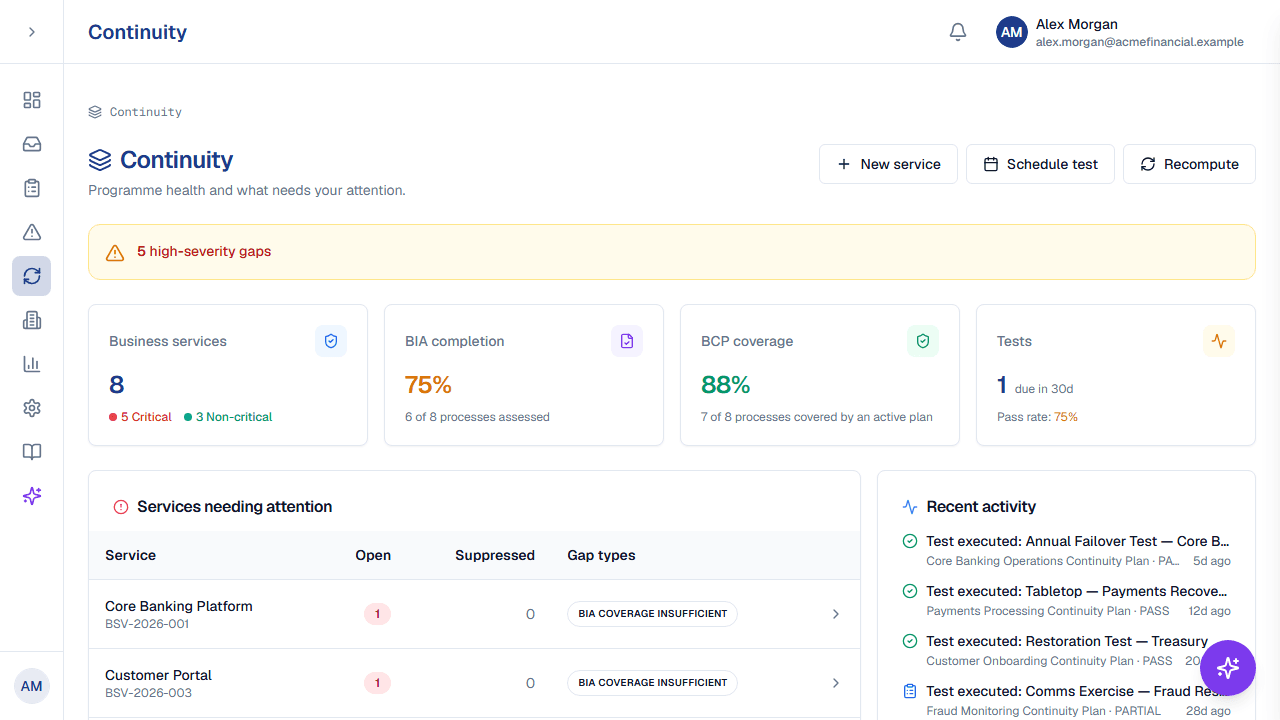
The BIA, the single points of failure, the tested recovery and the evidence trail, on one screen.
The continuity cycle
What’s critical → what we depend on → can we actually recover?
- 1
Know what's critical
Business impact analysis that ranks your processes and sets MTPD, RTO and RPO, signed off by the people who own them.
- 2
See what breaks you
Map what each process depends on (suppliers, applications, infrastructure, people) and surface single points of failure before they become incidents.
- 3
Choose recovery that hits the target
Compare recovery strategies (from hot standby to cloud failover to manual fallback), each with an achievable RTO/RPO and cost.
- 4
Prove it works
Plan, run and evidence exercises, capturing findings and corrective actions, tracked against the ISO 22301 lifecycle, plus DORA-aligned ICT resilience testing on the same data.
- 5
Stay current
Continuity shares data with your risk register and incidents, so when the business changes, the plans that depend on it don't quietly go stale.
If any of these sound familiar, your continuity lives in documents, not capability:
rAIley does the heavy lifting. You stay the approver.
rAIley suggests BIA ratings, drafts recovery strategies and test scenarios, then reviews your plans for gaps. Every suggestion is grounded in your own records and audit-logged. Nothing is finalised without you.
Frequently asked questions
- Real BCM. You run BIAs that set RTO/RPO/MTPD, find your single points of failure, choose recovery strategies with achievable targets, and run a tested exercise programme: the full ISO 22301 lifecycle, not a document you fill in once.
- Yes. Dependency mapping flags them across suppliers, applications, infrastructure and people, so you fix them before an incident finds them.
- Yes. It supports the ISO 22301 BCMS lifecycle and DORA-aligned ICT resilience testing on the same data.
Is this real BCM or just policy templates?
Does it surface single points of failure?
Is it aligned to ISO 22301 and DORA?
See continuity in ResiliencePilot
See it on your own data and frameworks, with your security and data-residency questions answered.